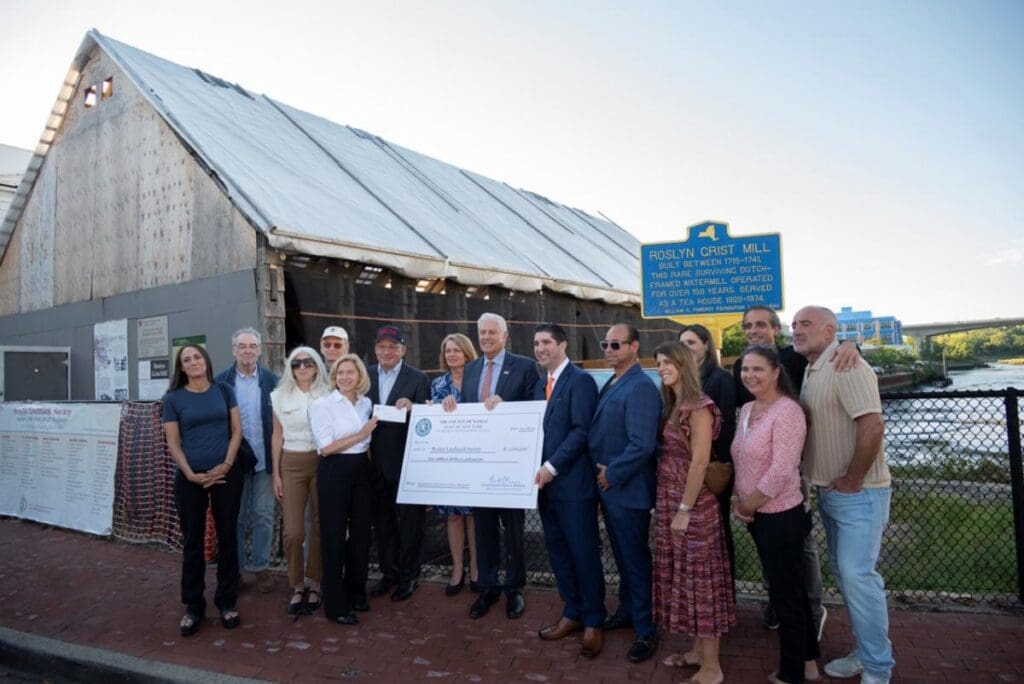
The Roslyn Grist Mill, one of Nassau County’s most important historic landmarks, is on track to complete its transformation into a public museum thanks to new county funding. On Monday, September 8, 2025, Nassau County Executive Bruce Blakeman visited the site to personally present the Roslyn Landmark Society with the first $1 million installment of a $2 million Capital Plan award earmarked for the mill’s restoration.
The funding, part of Blakeman’s 2025 Nassau County Capital Plan approved by the legislature in April, will allow the nonprofit Roslyn Landmark Society to finish rehabilitation work that has been underway for years. The completed project will turn the grist mill into an educational center, making the site accessible to the public for the first time since 1974, when the Tea House that once operated in the building closed.

The Roslyn Grist Mill, located at the head of Hempstead Harbor on Old Northern Boulevard, is a rare surviving Dutch-framed watermill dating back to 1698. Listed on the National Register of Historic Places, it is among the few remaining colonial grist mills in the New York metropolitan area and is believed to be the oldest surviving Dutch commercial building in the United States.
The mill’s historical significance stretches across centuries. John Robinson, who established the site in 1698 with permission from the Town of Hempstead, helped spur Roslyn’s early growth. In 1790, President George Washington visited the mill during his Long Island tour, meeting then-owner Hendrick Onderdonk. Later, Nassau County advocate Benjamin D. Hicks owned the property briefly in the late 19th century.

At the presentation, Blakeman described his commitment to the restoration as deeply personal, calling the project a “labor of love.” Howard Kroplick, co-president of the Roslyn Landmark Society, accepted the $1 million check and thanked the county for delivering on its promise of support.
The final phase of the restoration will focus on completing structural elements such as the roof, siding, floors, windows, and doors. Once these are finished, crews will reinstall the mill’s husk frame, relocate a storm water basin, construct a new water wheel, and create an ADA-compliant entrance to ensure accessibility.
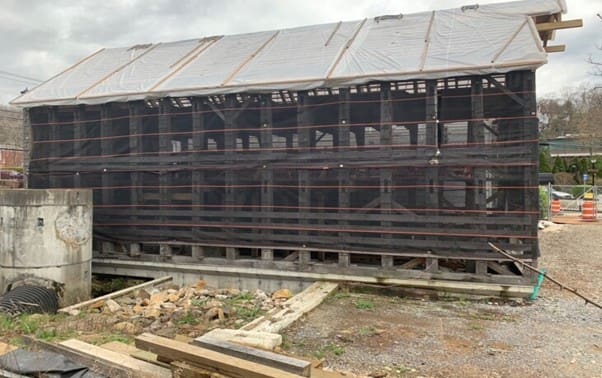
Jordan Fensterman, co-vice president of the Landmark Society, noted that the project’s completion within the next two years will open the site for school trips and community visits, solidifying its role as both an educational and cultural resource for Nassau County.