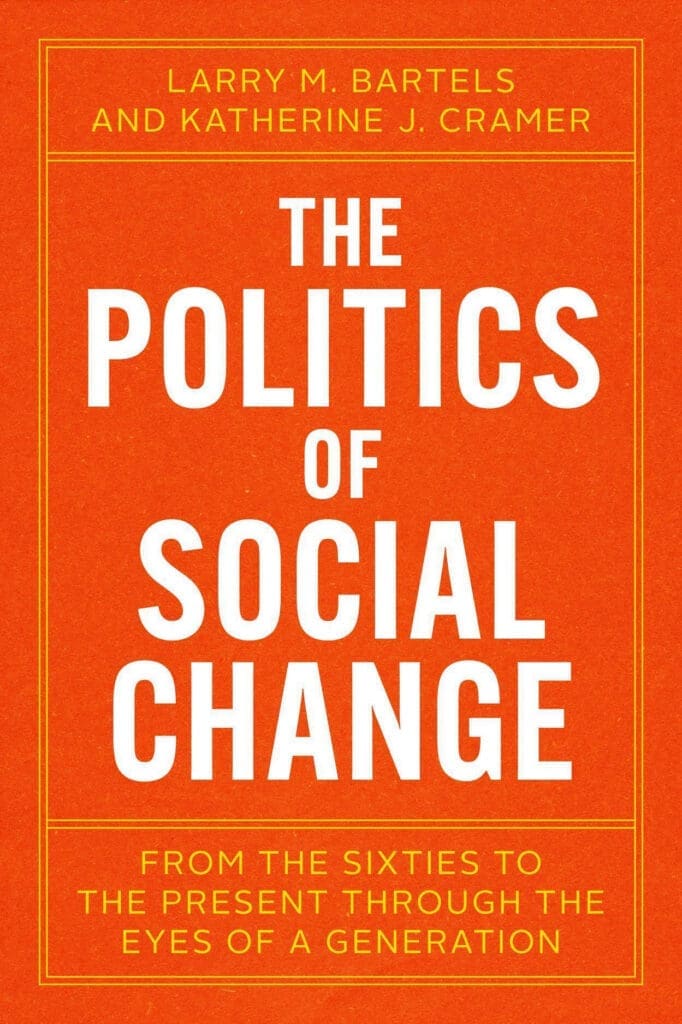
A sweeping new book is challenging the way Americans understand political division, arguing that today’s fractured landscape didn’t suddenly emerge—it was decades in the making.
In The Politics of Social Change, political scientists Larry M. Bartels and Katherine J. Cramer draw on an extraordinary long-term study to examine how everyday Americans experienced—and reacted to—the seismic cultural shifts of the 1960s and beyond. Their conclusion: it wasn’t just the events themselves, but the wide range of public responses to them, that laid the groundwork for today’s political polarization.
The book centers on a rare and ambitious research project that began in 1965, when hundreds of high school students across the United States were first interviewed about their political views. Over the following three decades, those same individuals were reinterviewed multiple times, creating one of the most comprehensive longitudinal studies of political attitudes ever conducted.
By revisiting members of the “Class of ’65” years later, Bartels and Cramer provide a uniquely personal and evolving portrait of how political identities are formed. Some participants embraced the sweeping changes of the era, including the Civil Rights Movement and the push for gender equality. Others resisted those changes, while many remained disengaged or conflicted. That range of reactions, the authors argue, is key to understanding the divisions that persist today.
The book explores how major historical forces—from the Vietnam War to shifting religious influences, economic inequality, and immigration—shaped political thinking over time. It also extends its analysis into the modern era, examining how those early attitudes evolved into the partisan dynamics that define contemporary politics, including the rise of figures like Donald Trump.
Rather than presenting political polarization as a recent phenomenon, The Politics of Social Change reframes it as the cumulative result of decades of lived experience. The authors suggest that Americans didn’t simply become divided overnight; instead, they gradually interpreted the same events in vastly different ways, reinforcing distinct worldviews over time.
Bartels, a distinguished professor at Vanderbilt University, and Cramer, a leading scholar at the University of Wisconsin–Madison, bring deep expertise to the subject. Both have built careers studying public opinion and political behavior, and their collaboration offers a data-rich yet deeply human account of American democracy in motion.
Ultimately, the book offers a sobering but nuanced takeaway: the roots of today’s political tensions are embedded in the past, shaped not only by policy and leadership, but by how ordinary people understood—and felt about—the changes unfolding around them.
For readers seeking to make sense of the current moment, The Politics of Social Change provides both historical context and a reminder that the story of American politics is, at its core, a story about people.