As companies race to incorporate artificial intelligence into their operations, many leaders are asking the same question: How can organizations stay competitive in an increasingly AI-driven world?
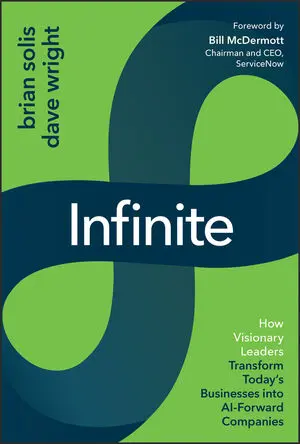
A new book from two technology industry veterans argues that the answer requires far more than simply adopting new software. In Infinite: How Visionary Leaders Transform Today’s Businesses into AI-Forward Companies, futurist Brian Solis and IT executive Dave Wright make the case that artificial intelligence should be viewed not as a tool, but as the foundation of an entirely new way of running organizations.
Scheduled for release on June 23, the book introduces what the authors call the “Infinite Company,” a new organizational model designed to thrive in an era where intelligence, adaptability and continuous learning drive competitive advantage.
Solis and Wright, both executives at ServiceNow, contend that many businesses are approaching AI with the wrong mindset. Rather than reimagining how their organizations operate, they argue that companies are often using AI simply to improve existing processes.
The authors describe this as the “Iteration Trap”—a situation in which businesses use artificial intelligence to optimize yesterday’s assumptions instead of preparing for tomorrow’s opportunities. While these improvements may increase efficiency in the short term, the authors warn they could leave organizations vulnerable to AI-native competitors that are building entirely new business models from the ground up.
At the heart of the book is a distinction between what Solis and Wright call “finite” and “infinite” organizations. Finite companies focus primarily on efficiency, productivity and predictable outcomes. Infinite companies, by contrast, are structured around continuous adaptation, intelligence and long-term growth.
According to the authors, AI-forward organizations are not simply deploying technology within existing systems. Instead, they are redesigning leadership strategies, decision-making processes and operating models around the capabilities of artificial intelligence.
The book arrives as AI adoption accelerates across industries, from healthcare and finance to manufacturing and retail. Executives are increasingly grappling with questions about workforce transformation, automation, innovation and long-term competitiveness.
Solis, known for his work as a digital analyst and futurist, has spent years examining the impact of emerging technologies on business transformation. Wright brings decades of experience in enterprise technology and IT leadership.
Together, they argue that organizations that embrace AI as a strategic philosophy rather than a productivity tool will be better positioned to navigate a rapidly changing business landscape.
As the AI revolution continues to reshape industries worldwide, Infinite offers leaders a framework for understanding what the next generation of successful companies may look like—and how to begin building them today.