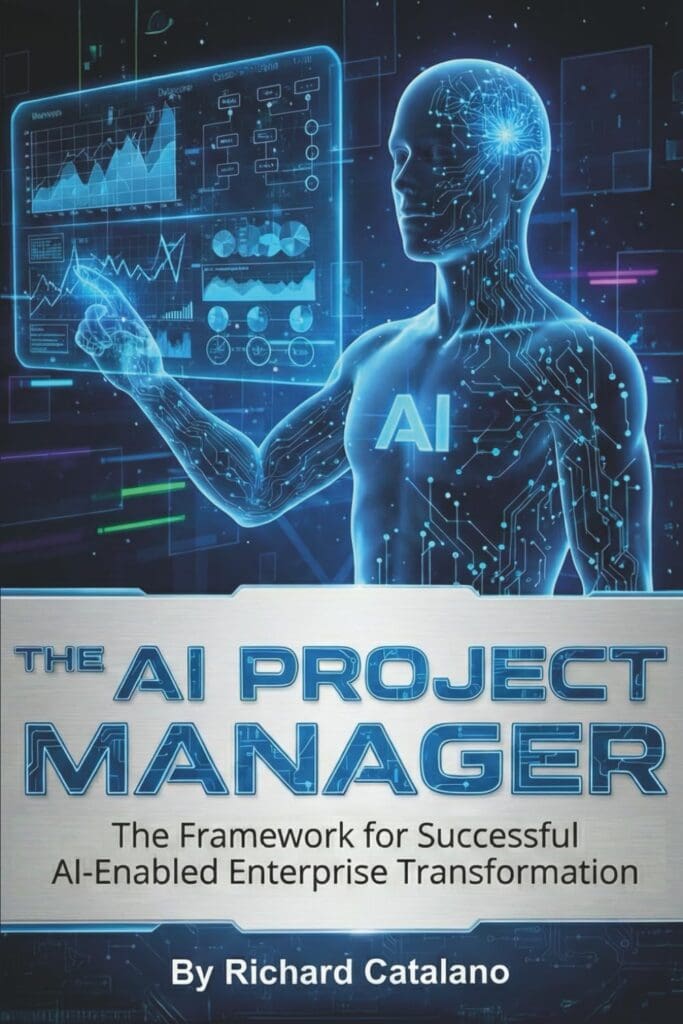
Artificial intelligence is rapidly becoming one of the biggest investments on the corporate agenda, but enterprise transformation expert Rick Catalano warns that AI is not a cure-all for problems that existed long before the technology arrived.
In his new book, The AI Project Manager: The Framework for Successful AI-Enabled Enterprise Transformation, Catalano argues that AI can dramatically increase an organization’s capabilities—but it can also amplify ineffective leadership, broken processes, poor data, weak governance and unclear objectives.
Drawing on 30 years of Fortune 500 experience with enterprise technology implementations involving SAP, Oracle and Salesforce, Catalano developed the AMIGA Framework to help leaders manage complex transformation projects. The framework focuses on six interconnected areas: People, Process, Technology, Data, Governance and Value.
The premise is straightforward: technology alone does not create a successful transformation. Employees must understand and support change, processes must be effective, data must be reliable, governance must be clear and the project must produce measurable business value.
That becomes particularly important as companies move from experimenting with AI to incorporating it into larger digital transformation initiatives.
Catalano cites transformation failure rates ranging from 65% to 85%, arguing that the problem is often not whether the technology works, but whether organizations have an effective framework for managing all the moving pieces.
AI can automate tasks, analyze information, identify patterns and support decision-making. But if a company has an inefficient process, automating it could simply make the process run faster. If its data is incomplete or unreliable, AI-generated analysis may be limited by the information available. And if executives cannot define success, they may struggle to determine whether an expensive AI investment actually improved the business.
The book includes more than 260 AI use cases and examples designed to help leaders apply AI across the transformation lifecycle. Catalano also emphasizes servant leadership and the importance of building trust among employees as organizations introduce increasingly powerful technologies.
Another focus is measuring results. Catalano says 73% of organizations cannot clearly explain what their transformation actually delivered, underscoring the importance of establishing measurable objectives before launching major initiatives.
For professionals, the book also explores opportunities in AI-enabled transformation leadership, including program management roles that can command significant compensation. An AI Project Manager Certification Program based on Catalano’s AMIGA Framework is scheduled to launch in July 2026.
As companies race to adopt AI, Catalano’s central message is that technology should follow strategy—not replace it. Businesses that establish strong leadership, effective processes, reliable data and measurable goals may be positioned to use AI as a powerful accelerator.
Those that do not could find themselves accelerating their existing dysfunction instead.