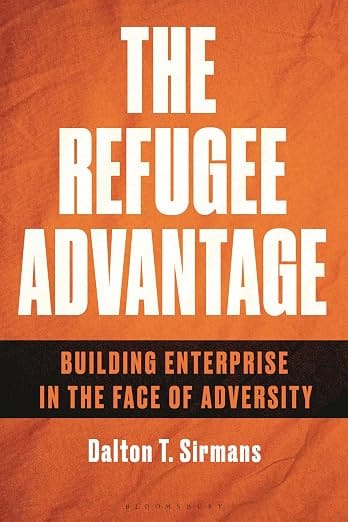
As companies across the globe grapple with labor shortages, talent gaps and economic uncertainty, a new book argues that one of the world’s most overlooked resources may be people who have been forced to rebuild their lives from scratch.
In The Refugee Advantage, author and impact investor Dalton T. Sirmans challenges conventional thinking about refugees, urging business leaders, investors and policymakers to view displaced populations not as a humanitarian burden, but as a valuable source of innovation, entrepreneurship and economic growth.
Scheduled for release on Aug. 6 through Bloomsbury Publishing, the book examines how refugees are contributing to local economies by launching businesses, filling critical workforce needs and bringing resilience forged through adversity.
“We often discuss refugees in this country only through the lens of crisis, cost and politics,” Sirmans said in a statement. “My work asks a different question. What happens when we examine refugees through the lens of contribution, entrepreneurship, labor and economic resilience?”
Drawing on graduate research conducted at Harvard University, along with years of experience in impact investing, Sirmans combines economic analysis with stories of refugee entrepreneurs from countries including Afghanistan, Syria, Vietnam and Eritrea. Their experiences illustrate how overcoming displacement often develops qualities such as adaptability, perseverance and problem-solving—traits many employers and business leaders actively seek.
The book argues that businesses willing to recruit, invest in and partner with refugee communities stand to gain from a largely untapped talent pool. Rather than focusing exclusively on humanitarian assistance, Sirmans encourages organizations to create pathways that allow refugees to contribute at the level of their education, skills and professional experience.
According to Sirmans, these efforts can generate benefits that extend well beyond individual workers, including increased productivity, business formation, job creation and stronger local economies.
“Refugees are not a burden,” he said. “They are an underleveraged economic resource. When refugees are properly supported and allowed to contribute at their skill level, communities and economies benefit through job creation, productivity and innovation.”
The book also offers recommendations for employers, investors and policymakers interested in building more inclusive hiring practices and expanding economic opportunities for displaced populations.
Beyond its message, The Refugee Advantage is tied to a broader philanthropic mission. Proceeds from the book and related initiatives will support refugee entrepreneurship through the Sirmans Global Impact Foundation, which invests in refugee-owned businesses and enterprises serving refugee communities.
At a time when employers continue searching for skilled workers and new avenues for growth, Sirmans hopes the book will shift the conversation beyond politics and toward economic opportunity.
His central argument is that investing in refugee talent is not simply an act of compassion—it is also a practical business strategy that can strengthen companies, create jobs and contribute to long-term economic resilience for both refugees and the communities that welcome them.