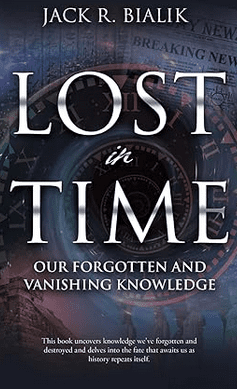
In an era dominated by cloud storage, artificial intelligence, and instant access to information, humanity may be sleepwalking into a digital dark age, warns engineer and innovator Jack R. Bialik. His new book, Lost in Time: Our Forgotten and Vanishing Knowledge, offers a compelling exploration of how centuries of human ingenuity have been lost—and why today’s digital methods may be putting our collective memory at unprecedented risk.
Bialik highlights the fragility of modern preservation. “A DVD or a CD … those only last 30 or 40 years,” he says. “Thumb drives or solid-state drives … how long do those last? Five or 10 years? We’re taking our information, putting it on denser things with no thought about how long it lasts.” According to Bialik, only 1.6 percent of humanity’s knowledge has been preserved over time, a sobering reality that underscores the urgency of safeguarding wisdom for future generations.
Lost in Time guides readers through centuries of forgotten accomplishments, revealing the technologies, philosophies, and cultural practices of civilizations that have disappeared under the sands of history. Bialik challenges the assumption that innovation is uniquely modern, illustrating that ancient societies often achieved feats that rival or surpass contemporary solutions. Among the book’s fascinating revelations: cataract surgery was performed in India over 2,000 years ago, early fountain pens predated their European counterparts by centuries, and ancient civilizations debated sanitation and waste solutions that sometimes exceeded modern systems.
Through over a decade of meticulous research, Bialik connects these historical achievements to modern challenges, highlighting lessons in sustainability, innovation, and societal resilience. He emphasizes that preserving knowledge is not enough; it must be transformed into wisdom to be truly enduring. “We keep trying to save knowledge, and what we need to do is turn the knowledge into wisdom so that it can be saved from generation to generation,” Bialik asserts.
The book also examines the forces that contribute to knowledge loss—war, natural disasters, and shifting cultural priorities—while celebrating human curiosity and ingenuity. Bialik’s storytelling makes the past accessible, encouraging readers to consider what is being lost today as society increasingly depends on digital storage and fleeting technologies.
From history enthusiasts to students and lifelong learners, Lost in Time offers a lens to reflect on humanity’s past achievements and a call to action for preserving knowledge for the future. Bialik’s work is both a cautionary tale and a tribute to resilience, reminding readers that while information can vanish, the lessons and creativity of humanity can endure if we safeguard them wisely.
Lost in Time: Our Forgotten and Vanishing Knowledge is published by Mill City Press, 266 pages, and is available on Amazon.