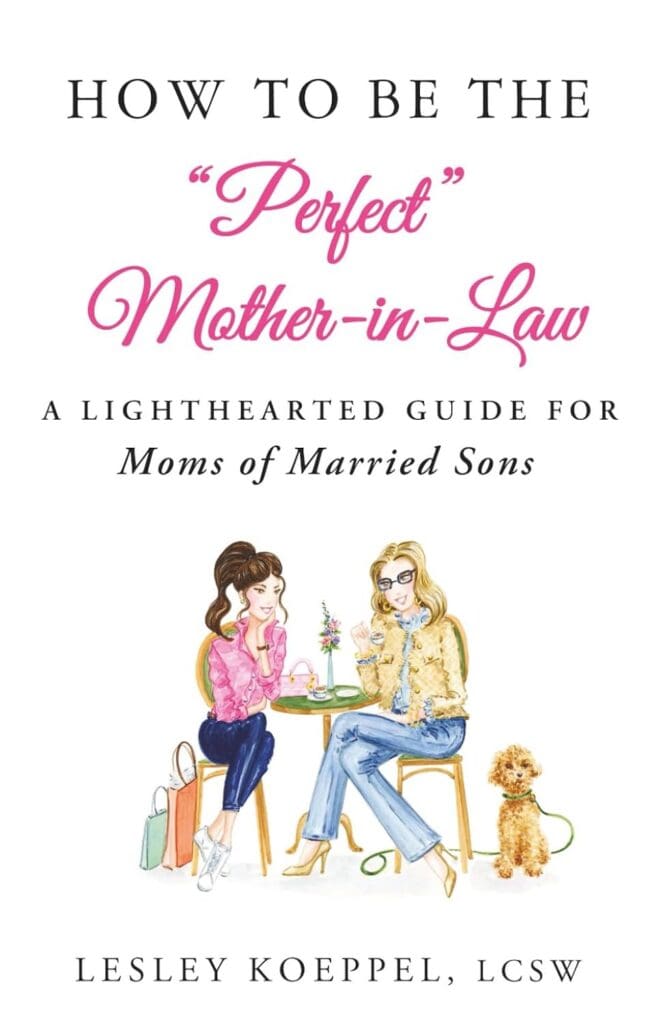
To help mothers of the groom avoid common pitfalls, licensed clinical social worker and trauma therapist Lesley Koeppel has released How to Be the “Perfect” Mother-in-Law: A Lighthearted Guide for Moms of Married Sons, a book that offers practical advice for supporting couples while minimizing unnecessary conflict.
Koeppel, who has more than 30 years of experience as a psychotherapist and is the mother of two married sons, says becoming a mother-in-law can bring unexpected emotions.
“It may not be a role we talk about often, and when we do, it is usually the punchline of a joke,” Koeppel said. “But becoming a mother-in-law can stir up surprising anxiety, frustration, and family drama when the unspoken rules are not understood.”
Her advice centers on recognizing that the wedding belongs to the couple—not their parents.
Among her recommendations is a reminder that financial contributions do not give parents control over wedding decisions. She also encourages mothers of the groom to ask permission before offering opinions, rather than assuming advice is welcome.
Another key principle is supporting a son without criticizing or undermining his future spouse. Koeppel says mothers should avoid trying to manage the bride’s emotions during what is often a stressful period and instead offer empathy and encouragement.
She also advises respecting boundaries, noting that “no” should be accepted without argument, whether the issue involves wedding plans, family traditions, or guest lists.
Guest lists, in particular, can become a source of lasting family conflict. Koeppel recommends staying out of those discussions unless the couple specifically requests input.
On the wedding day itself, she says the mother’s role should be to provide calm rather than direction.
Instead of organizing vendors, correcting details, or solving every problem, Koeppel suggests focusing on celebrating the occasion and allowing the couple and wedding professionals to manage the event.
She also encourages families to embrace evolving traditions, recognizing that modern couples often personalize ceremonies in ways that differ from past generations. Those choices, she says, should not be viewed as a reflection of love or appreciation.
The guidance comes as wedding etiquette continues to evolve alongside changing family dynamics, with many couples placing greater emphasis on setting boundaries and making decisions that reflect their own values.
While every family is different, Koeppel believes one principle applies broadly: the less parents make the day about themselves, the more meaningful it becomes for everyone involved.
Her book aims to help mothers of the groom build positive, long-term relationships with their new daughters-in-law—starting with one of the family’s most memorable days.