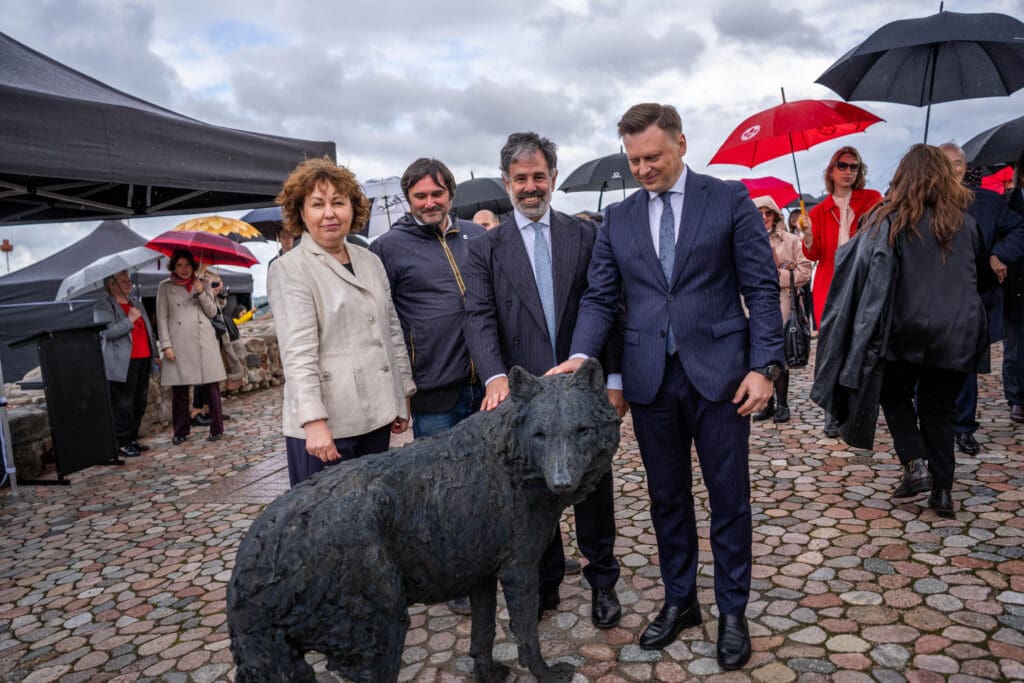
Vilnius is adding a striking new work of contemporary art to one of Lithuania’s most historic sites, creating a symbolic connection between the Lithuanian capital and Rome through two cities’ legendary associations with wolves.
On June 16, Vilnius unveiled Wolf, a life-sized bronze sculpture by acclaimed Italian artist Davide Rivalta on Gediminas Hill. The installation is a collaboration between Lithuania and Italy marking 35 years since the restoration of diplomatic relations between the two countries.
The location carries particular significance. Gediminas Hill is closely tied to the founding legend of Vilnius, in which Grand Duke Gediminas dreamed of an iron wolf whose powerful howl foretold the establishment of a great city. According to the legend, Gediminas subsequently built a castle on the hill.
Rome has its own legendary wolf. The Capitoline Wolf is traditionally associated with the story of Romulus and Remus, the twin brothers said to have been raised by a she-wolf before Romulus founded Rome.
Rivalta’s sculpture brings the two legends together in a contemporary setting, positioning the bronze animal at the viewing platform on Gediminas Hill. The installation also adds another layer to the longstanding cultural relationship between Lithuania and Italy.
The countries’ connections extend back centuries, with Italian architects, sculptors and painters playing an important role in shaping Vilnius’ distinctive Baroque architecture. The city’s UNESCO-listed Old Town contains numerous examples of Italian artistic influence.
At the Church of St. Peter and St. Paul in Antakalnis, more than 2,000 stucco figures created by Italian masters Giovanni Pietro Perti and Giovanni Maria Galli cover the interior. Pacai Palace also brought together prominent Italian artists, including architect Giovanni Battista Frediani, stucco artist Perti and painter Michelangelo Palloni.
Italy’s influence is also connected to Bona Sforza, the Italian-born Grand Duchess of Lithuania and Queen of Poland, whose influence extended across the political, cultural and economic life of the Grand Duchy during the 16th century. Her legacy is explored at the Palace of the Grand Dukes of Lithuania and commemorated in nearby Bona Sforza Square.
The new sculpture builds on that history while giving visitors a contemporary reason to engage with it.
Born in Bologna, Rivalta is known for his life-sized animal sculptures installed in public spaces. His works have appeared across Italy as well as internationally, including in Dublin and Oslo.
For Vilnius, Wolf is more than a new public artwork. It links mythology, diplomacy, history and contemporary culture in a single landmark, inviting residents and visitors to consider the stories that have shaped two European capitals—and the cultural connections that continue to bring them together.