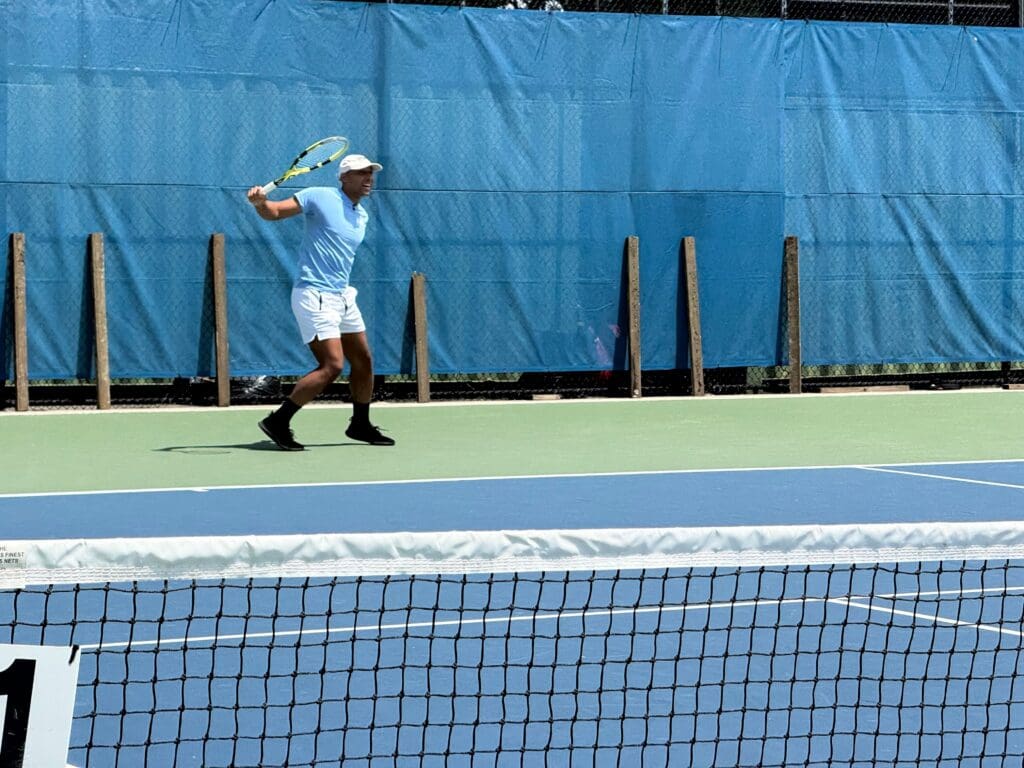
New York Junior Tennis & Learning (NYJTL) welcomed New York City Department of Health and Mental Hygiene Commissioner Dr. Alister F. Martin to its Cary Leeds Center for Tennis & Learning in the South Bronx for an on-court session with young athletes and a conversation about the role tennis played in shaping his career in public health.
The July 31 visit brought together Martin, a former collegiate and professional tennis player, and NYJTL students at the organization’s flagship facility in Crotona. The discussion focused on athletics, education, perseverance and the ways lessons learned through sports can influence a person’s future.
A New York City native, Martin spent his early childhood in Queens before moving to New Jersey. His introduction to tennis came during a high school summer job sweeping at a local tennis club. The experience sparked an interest in the sport that eventually led him to the Nick Bollettieri Tennis Academy in Bradenton, Florida, where he trained alongside aspiring elite players.
After high school, Martin put his education on hold to pursue competitive tennis. In 2006, an assistant coach recruited him to Rutgers University and encouraged him to take the GED and resume his education.
At Rutgers, Martin became involved with a program supporting students pursuing excellence in science and mathematics. That experience helped him discover an interest in medicine and ultimately led him to Harvard Medical School and later the Harvard Kennedy School of Government.
Martin went on to build a career in public health policy at the federal and state levels before becoming commissioner of the city’s Department of Health and Mental Hygiene in January.
“I am thrilled to have had the opportunity to meet such talented and passionate young tennis players,” said Dr. Alister F. Martin, Commissioner of the NYC Department of Health and Mental Hygiene. “Tennis has always held a special place in my heart. It not only taught me the value of discipline and perseverance but the sport also led me to discover my passion for health. The lessons I learned on the court—teamwork, resilience, and the importance of staying active—have shaped who I am today, as NYC Health Commissioner. I hope these young athletes continue to embrace the sport, beyond competition, but for the lifelong skills and joy it brings.”
NYJTL President and CEO Udai Tambar said the organization views tennis as a pathway to opportunity and personal development.
“At NYJTL, we know that tennis is a gateway to opportunity, helping young people build confidence, resilience, and lifelong healthy habits,” said Tambar. “Dr. Martin showed our students that lessons learned on the tennis court can lead to extraordinary paths of service and leadership. We were honored to welcome him to the Cary Leeds Center and hear him share his story, and journey, with the next generation.”
NYJTL reaches more than 90,000 young people annually through tennis, education, afterschool programming, mental health and wellness support, and college pathway initiatives. Its mission is to develop young people’s character through tennis and education, with the Cary Leeds Center serving as a central community resource in the Bronx.