The Lithuanian capital is shedding new light on a vital chapter of its history with the opening of Unearthing the Great Synagogue of Vilna, an exhibition that showcases remarkable archaeological discoveries from the site of one of Eastern Europe’s most significant Jewish landmarks.
Opening May 19 at the Vilnius Gaon Museum of Jewish History and running through Jan. 31, 2027, the exhibition presents thousands of artifacts uncovered during a decade-long international excavation of the Great Synagogue of Vilnius, once the spiritual and cultural center of Jewish life in Lithuania.
Often referred to as the “Jerusalem of the North,” Vilnius was home to a thriving Jewish community for centuries. Built in the 17th century, the Great Synagogue stood at the heart of that community alongside the bustling shulhoyf, a complex that included prayer houses, shops, meeting halls and the famed Strashun Library. The synagogue also became closely associated with the Vilna Gaon, one of Judaism’s most revered scholars.
The synagogue was heavily damaged during World War II and later demolished by Soviet authorities between 1955 and 1957, erasing one of the city’s most important historical landmarks. Since 2011, however, archaeologists from Lithuania, Israel and the United States have worked together to recover what remained beneath the site.
Their efforts uncovered nearly 5,000 artifacts dating from the 16th through the 20th centuries, including architectural fragments from the synagogue’s bimah, coins, household objects and religious items that offer new insight into everyday Jewish life before the Holocaust.
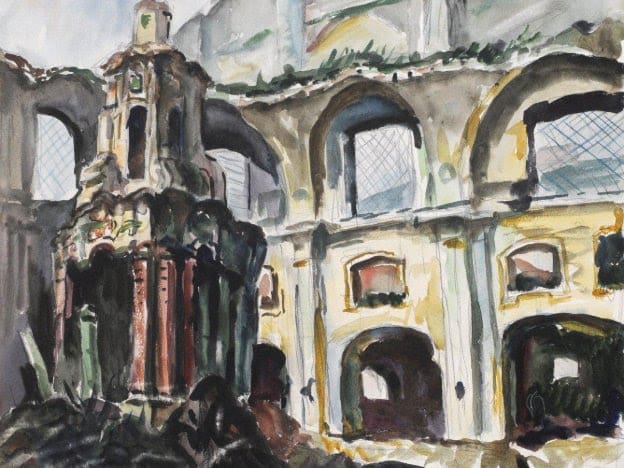
The exhibition also features haunting paintings by artist Rafael Chwoles, who documented the synagogue’s ruins shortly after World War II. Created between 1945 and 1949, his works serve as some of the few surviving visual records of Jewish Vilnius during the city’s postwar devastation.
Complementing the archaeological exhibition is a contemporary art installation by Lithuanian artist Eglė Ridikaitė. Inspired by decorative floor patterns uncovered during the excavation, her large-scale paintings recreate architectural elements of the synagogue, including columns and the historic mikvah. The works are displayed inside the recently reopened Church of St. George in Vilnius’ Old Town.
The exhibition arrives as heritage tourism continues to gain popularity among travelers seeking deeper cultural experiences. Rather than simply visiting famous landmarks, many tourists are increasingly drawn to destinations that preserve memory, history and identity.
Compact, walkable and rich in architectural beauty, Vilnius offers visitors the opportunity to explore centuries of multicultural history while reflecting on the resilience of a community whose legacy continues to shape the city today. Through archaeology, art and remembrance, Unearthing the Great Synagogue of Vilna restores an important piece of that story for future generations.