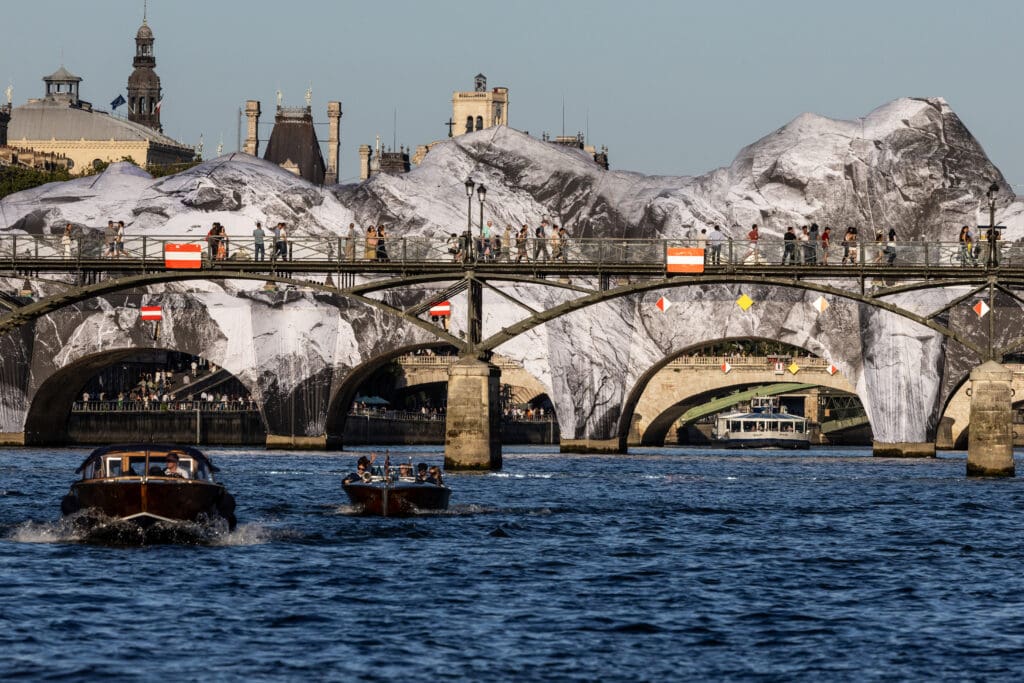
A temporary work of art in the heart of Paris has drawn millions of visitors, demonstrating the continued power of large-scale public art to attract tourists and locals alike.
La Caverne du Pont Neuf, the massive installation created by French artist JR, was viewed in person by an estimated 6.4 million people between its unveiling on May 20 and its closure to the public on June 28, according to Paris je t’aime, the city’s tourism office.
The estimate was based on data provided by Orange Flux Vision Tourisme. The attendance figures put the installation among Paris’ most successful recent public art projects and even surpassed the average daily attendance of the Louvre during the exhibition period.
Inside La Caverne, an average of 41,154 visitors-explorers entered the installation each day. The scale of the response is particularly notable given that Paris experienced 21 days of intense heat during the measurement period, prompting some residents to remain indoors and leading some travelers to cancel trips to the French capital.
The installation’s popularity also echoes the response to another major Paris art spectacle. Five years after Christo and Jeanne-Claude’s L’Arc de Triomphe, Wrapped attracted an estimated 6 million visitors, La Caverne du Pont Neuf exceeded that figure, underscoring the public’s appetite for immersive art in iconic urban spaces.
The project also appears to have boosted international interest in Paris. During the June 15–28 opening period, several international visitor groups were represented at higher levels than during the same period in 2025. Visitors from the United States increased 14.1%, while arrivals from Canada rose 23.3%. Argentina saw an increase of 54.7%, followed by South Korea at 7.5%, the Netherlands at 17.5% and the Czech Republic at 15.1%.
The installation generated more than 3,000 online articles worldwide, adding to the international attention surrounding the project.
Although La Caverne itself is temporary, its materials will have a life beyond the exhibition. The artwork will be completely dismantled on July 13, with 90% of the materials set to be reused.
That includes the installation’s exterior fabric, or iconic envelope, which will be repurposed through a strategy built around three ideas: connect, shelter and inspire.
For Paris, the project offered more than a striking visual transformation of a historic landmark. It became a tourism draw, an international talking point and another example of how ambitious public art can reshape the way visitors experience a city.
As Paris je t’aime Managing Director Corinne Menegaux noted, the early figures point to the cultural, media and tourism impact of the project — and reinforce the city’s belief that bold artistic initiatives can help attract visitors and inspire the public imagination.