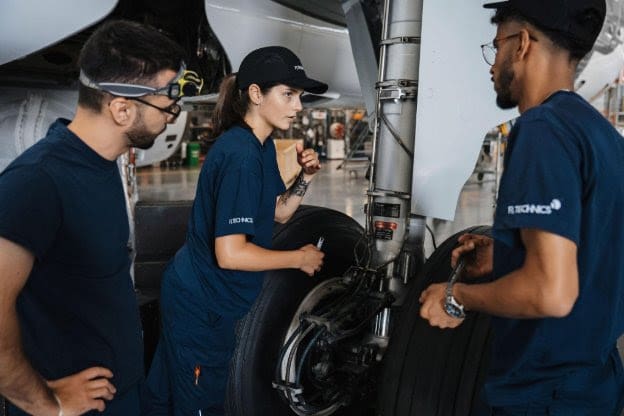
As artificial intelligence, automation, and digital modeling tools transform industries worldwide, the aviation maintenance sector is taking a more measured approach. For companies like FL Technics, innovation must always pass one critical test: proven safety value.
Aircraft maintenance, repair, and overhaul — commonly known as MRO — operates under some of the strictest regulatory standards of any industry. That caution has helped make air travel the safest mode of transportation globally, with nearly 100 million flight movements and approximately 9.8 billion passengers recorded annually. Industry leaders say maintaining that safety record requires careful evaluation before introducing new technology into operational environments.
FL Technics, which is preparing to open a new maintenance hangar in Punta Cana, is investing heavily in digitalization to improve efficiency and workflow planning. However, company executives emphasize that technology adoption is driven by measurable outcomes rather than hype.
According to Juozas Lapeika, deputy CEO for Base Maintenance, the company prioritizes tools that reduce aircraft turnaround times while maintaining uncompromised safety standards. That philosophy reflects what industry insiders often describe as “practical innovation,” where advancements are implemented only after demonstrating clear operational benefits.
One major focus area is data reliability. Digital systems allow maintenance teams to monitor bottlenecks in real time, allocate resources more effectively, and collaborate with airline clients using accurate performance insights. These capabilities support more precise planning, which is critical when aircraft downtime directly affects airline schedules and profitability.
FL Technics is also introducing specialized technologies designed to improve inspection accuracy. For example, dentCHECK devices — handheld wireless scanners with augmented reality capabilities — provide immediate structural measurements, reducing subjectivity during inspections. Maintenance teams are also testing helium-based leak detection methods, which use tracer gas to identify issues faster and more precisely than traditional techniques.
Automation is another area of gradual adoption. Rather than replacing workers, robotic tools are being used to handle repetitive tasks, allowing skilled technicians to focus on complex maintenance procedures that require human expertise.
The company plans to apply this same safety-first philosophy at its new Caribbean facility. Digital tools will support workflow efficiency and decision-making, but only when they demonstrably enhance operational stability.