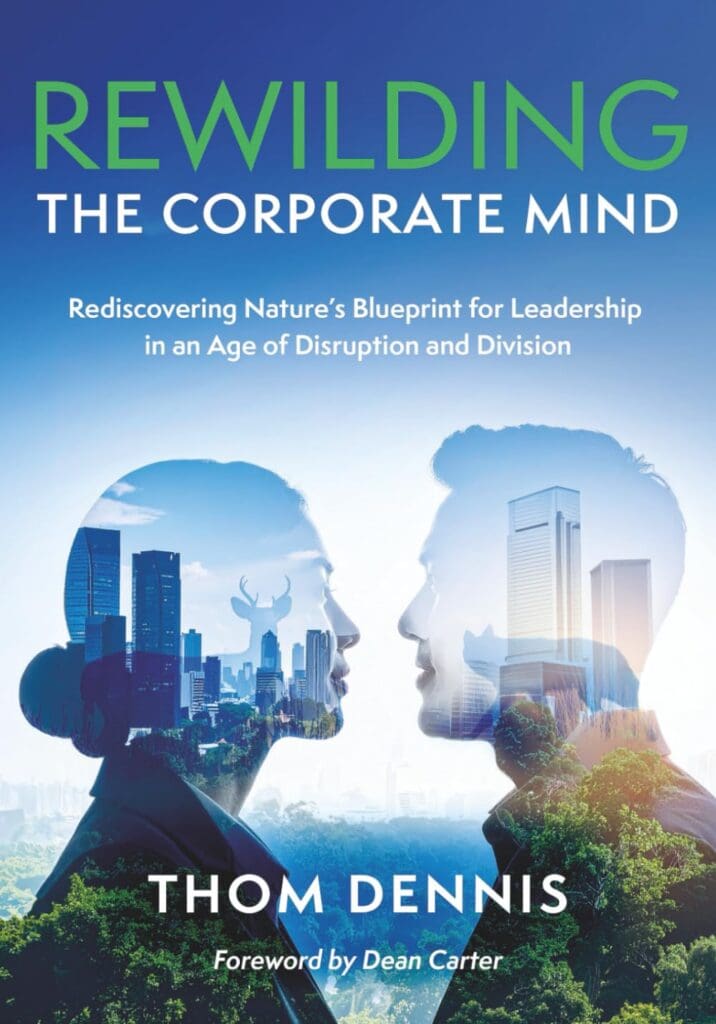
For more than a century, businesses have largely relied on hierarchy, control, efficiency and predictability to keep organizations running. But global leadership strategist Thom Dennis argues that the model that helped build the modern economy may not be equipped for a workplace increasingly defined by uncertainty, artificial intelligence, rapid change and human complexity.
In his new book, Rewilding the Corporate Mind: Rediscovering Nature’s Blueprint for Leadership in an Age of Disruption and Division, Dennis proposes a different approach: leaders should look to living systems for lessons in how organizations can adapt, collaborate and thrive.
Dennis, CEO of Serenity in Leadership and a former Royal Marines officer, draws on more than 30 years of experience in leadership, culture transformation and human development. His professional experience spans industries including pharmaceuticals, banking, energy, engineering, software, entertainment and professional services.
“Most leadership books give you a better map of the same territory,” Dennis said. “This one changes the territory.”
The central premise of Rewilding the Corporate Mind is that organizations can function more effectively when they operate less like machines and more like healthy ecosystems. Dennis points to principles found throughout nature—including diversity, adaptation, interdependence, feedback, regeneration and shared stewardship—as potential models for modern leadership.
That philosophy also reframes some of the most persistent problems facing employers. Burnout, disengagement, declining trust and workplace fragmentation, Dennis argues, should not automatically be treated as individual employee problems. They can also reflect leadership structures and cultural practices inherited from an earlier industrial era.
The book arrives as companies continue to navigate major changes in how people work and how businesses operate. Artificial intelligence is transforming jobs and decision-making, while employees and executives alike are confronting questions about purpose, connection and resilience.
Dennis believes organizations need more than new technology to navigate those challenges. He advocates combining analytical thinking with empathy, intuition, courage and collective intelligence.
New York Times bestselling author Marianne Williamson praised the book for challenging what she described as the limitations of mechanistic thinking and offering an alternative centered on connection and vitality.
The philosophy presented in the book is part of a broader interest in regenerative leadership and systems thinking, with figures including King Charles III, Paul Hawken and Kate Raworth among voices associated with related ideas.
Dennis stresses that his approach does not mean abandoning performance or discipline.
“This isn’t about abandoning discipline or performance,” he said. “It’s about recognizing that the organizations and their leaders best prepared for the future will be those that understand how living systems actually thrive.”
Published by Serenity in Leadership, Rewilding the Corporate Mind is aimed at executives, managers, coaches, consultants and other changemakers seeking new approaches to leadership in an increasingly complex world.