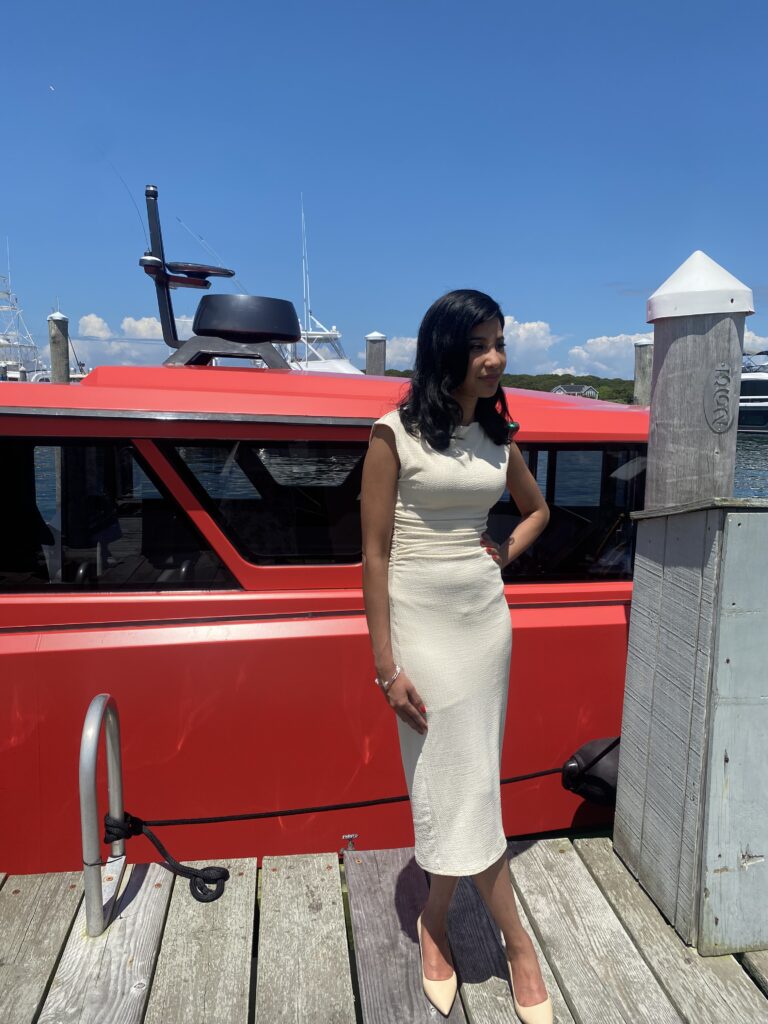
At the Montauk Yacht Club this July, the sea seemed to hum with a new kind of energy. It wasn’t the growl of gas engines or the chop of waves against hulls. Instead, it was the near-silent lift of Navier’s N30 Pioneer, an all-electric hydrofoiling boat that glides four feet above the water, leaving almost no wake behind. Guests at the House of Navier showcase leaned over the dock as the vessel skimmed across the surface, as if defying the rules of boating itself.
For Sampriti Bhattacharyya, Navier’s founder and CEO, the moment was more than a product launch. It was the physical embodiment of a question that has guided her since childhood in Calcutta: “Why not? Why?”
From Calcutta to MIT: A Relentless Curiosity
Bhattacharyya grew up oceans away from Montauk, in Kolkata (formerly Calcutta), India, where she says her teachers once told her to stop dreaming of science and prepare to be a housewife. But curiosity proved louder than convention. “I’ve always believed so-called ordinary people are capable of extraordinary things,” she told attendees at the Montauk event.
That belief propelled her to MIT, where she became fascinated with the ocean. At the Institute, she developed autonomous underwater drones capable of scanning nuclear reactors, tracking oil spills, and even searching for lost planes. Her work attracted NASA and Fermilab, where she studied robotics and advanced control systems, but it was the sea that ultimately claimed her imagination.
“The ocean is one of the last great frontiers,” she said. “Forty percent of the world’s population lives near waterways, but boats are shockingly inefficient. If we can figure out how to move through water cleanly and efficiently, it’s like unlocking another highway.”
The Birth of Navier
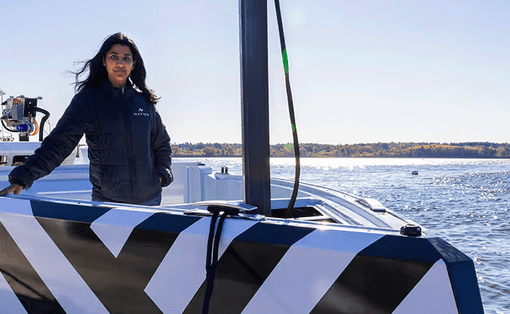
In 2020, Bhattacharyya founded Navier, a venture-backed, woman-led startup that set out to do what many thought impossible: build zero-emission boats that were not only sustainable but also high-performing and economically scalable.
The name pays homage to Claude-Louis Navier, the 19th-century physicist whose equations remain the cornerstone of fluid dynamics.
By adapting lessons from aerospace and automotive engineering, Navier began developing hydrofoiling electric boats—vessels that rise above the water’s drag, dramatically cutting resistance, energy use, and costs. Their debut model, the N30 Pioneer Edition, is a 30-foot carbon fiber craft with cork decking, twin 90-kilowatt motors, and a range of 75 nautical miles at cruising speed.
“We’re not just building vessels,” Bhattacharyya emphasized. “We’re developing the maritime tech stack: smarter systems, autonomous capabilities, advanced manufacturing. We’re rethinking how boats are designed, built, and deployed.”
The House of Navier in Montauk
That vision was on full display at the House of Navier showcase, a two-day pop-up salon hosted with Forbes’ Maneet Ahuja. Designed as a “living showroom,” the event blended sea trials with intimate conversations, luxury collaborations, and fireside chats on the future of sustainable travel.
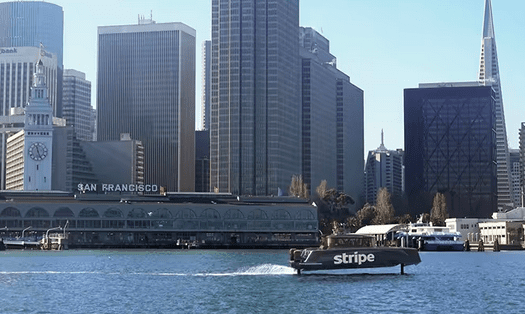
“The House of Navier is where a new era of nautical adventure begins—one rooted in harmony with nature, sustainability, and the spirit of exploration and innovation,” Bhattacharyya told the assembled investors, cultural leaders, and media figures.
Guests who stepped aboard the N30 Pioneer experienced firsthand the boat’s defining magic trick: at 16 knots, the vessel quietly lifts out of the water, soaring on computer-controlled foils that smooth out waves and eliminate seasickness. “It’s the same principles as an airplane,” Bhattacharyya explained. “Physics and math are universal languages.”
Onboard sensors and AI-driven systems make the N30 capable of automatic docking, adjusting in real time for wind and tide. Compared to traditional boats, Navier’s design slashes operating costs by 90 percent—an efficiency leap that could transform coastal mobility.
“Imagine ferries functioning like buses,” Bhattacharyya said. “You don’t need special infrastructure. A trip that takes two hours by car could take 30 minutes on a hydrofoiling vessel. That’s the future we’re building toward.”
A Path Paved with Resistance
That future has not come easily. “Maritime is a very white, very male industry,” Bhattacharyya admitted. “Doing this as a woman, with my accent, makes me appear as an outlier. Sometimes I get mistaken for the marketing person, not the CEO.”
Yet she also sees advantage in defying expectations. “When you do things people don’t expect, it opens minds. Once Navier succeeds, it won’t just be about me—it will open doors for other women, too.”
She speaks candidly about fundraising challenges, about investors who doubted her vision or dismissed her outright. “Relationships matter,” she said, “but merit matters more. We raised capital from those who believed in both.”
That combination of grit and clarity has attracted top-tier backers, enabling Navier to move from prototype to production in just three years. The first customer delivery happened in 2024, with a backlog of orders still growing.
Beyond Luxury: A Scalable Vision
While Navier’s early adopters include private buyers and luxury resorts—like its partnership with the Four Seasons—Bhattacharyya insists the long-term play is public transport.
“Boats that fly may sound like toys for the wealthy,” she said, “but the bigger vision is ferries and coastal mobility. Clean, scalable, zero-emission transport for people and goods. If we can prove it works in leisure, it can scale to infrastructure.”
Already, coastal markets are taking notice. Cities exploring alternatives to congested roads see in Navier’s technology a blueprint for sustainable transit. “If you can move on water efficiently,” Bhattacharyya said, “you unlock an entirely new layer of mobility.”
The Human Element
For all her technical expertise, from her PhD work on autonomous systems and her robotics background to her aerospace training, Bhattacharyya returns often to the human story.
“Curiosity is what drives us,” she reflected. “At the end of the day, it’s about solving blind spots in mobility, asking why we accept inefficiencies, and daring to imagine another way.”