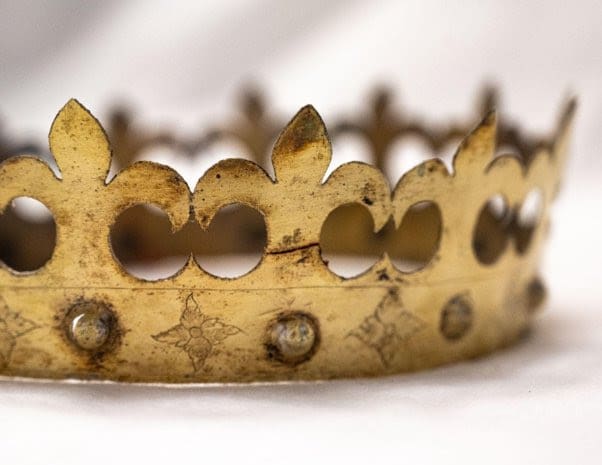
A collection of rare 16th-century royal burial insignia belonging to Lithuanian-Polish monarchs will go on public display for the first time in nearly a century this summer, offering visitors an extraordinary glimpse into Renaissance royalty and one of Europe’s most significant recent archaeological discoveries.
Beginning July 9, the Vilnius Church Heritage Museum in Lithuania will present “Hidden Within,” an exhibition showcasing the royal regalia of King Alexander Jagiellon, Queen Elizabeth of Austria, and Queen Barbara Radziwill. The artifacts, which include ceremonial crowns, jewelry, a scepter, and an orb, were rediscovered in 2024 after spending decades hidden beneath the crypts of Vilnius Cathedral.
The treasures were originally uncovered in 1931 after flooding exposed the cathedral’s royal crypts. As World War II approached, church officials concealed the valuable artifacts to protect them from theft or destruction. Although portions of the cathedral’s treasury resurfaced in 1985, the royal insignia remained missing for decades, fueling speculation about whether they had been lost forever.
Their rediscovery has drawn international attention, particularly in Poland and Lithuania, where the Jagiellonian dynasty played a pivotal role in shaping both nations’ histories.
“Most of Poland’s royal regalia were lost at the end of the 18th century, making this discovery internationally significant,” said Andrzej Betlej, director of Wawel Royal Castle in Kraków. He described the find as a “historic moment” and a symbolic restoration of an important chapter in the shared history of Poland and Lithuania.
Among the exhibition’s highlights are three royal funeral crowns, four gold rings adorned with diamonds, emeralds, and rubies, a gold chain belonging to Queen Barbara Radziwill, and an exceptionally rare medallion created from a unique 10-ducat coin minted in 1533. The medallion features portraits of King Sigismund the Old and Sigismund II Augustus and is believed to be the only known example of its kind.
Curator Dr. Giedrė Mickūnaitė noted that personal royal regalia made specifically for individual rulers are exceptionally rare because most coronation regalia were reused, melted down, or lost over the centuries.
Following decades in damp underground conditions, conservators faced significant challenges preserving the fragile artifacts. While precious metals survived relatively well, many items showed signs of deterioration after being wrapped in newspapers before being hidden during the war. Extensive conservation work has stabilized the collection for public display.
The exhibition also traces the remarkable story of the treasures’ concealment, disappearance, and eventual rediscovery, placing the artifacts within the broader history of Vilnius Cathedral, where generations of Lithuanian rulers were crowned, buried, and commemorated.
For historians and visitors alike, the exhibition represents a rare opportunity to view authentic Renaissance royal objects that many believed had vanished forever, offering new insight into the artistic craftsmanship and dynastic history of Central and Eastern Europe.