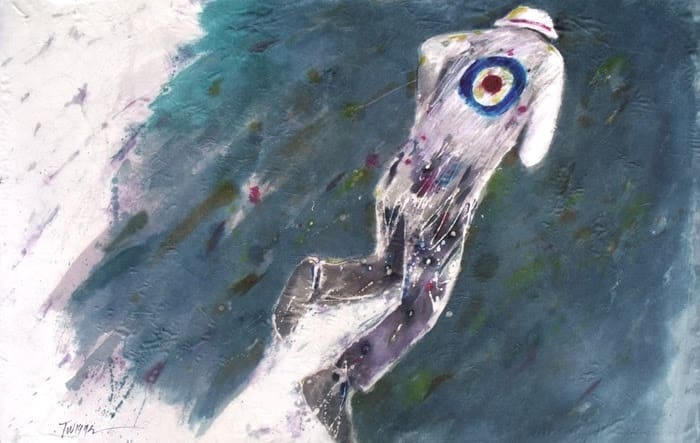
As the nation approaches its 250th anniversary, a powerful new exhibition is inviting audiences to reflect on America’s past and present through the work of one of its most enduring artists. Revelations: The Art of Leo Twiggs, now on view at the Gibbes Museum of Art through May 3, offers a sweeping retrospective of Leo Twiggs, whose career spans more than six decades.
The exhibition arrives at a significant moment for Twiggs, who celebrates his 92nd birthday this month. Widely recognized for his use of batik on cotton, Twiggs has built a legacy of confronting difficult truths embedded in American history, particularly through Southern symbolism. His work frequently interrogates the legacy of the Confederate flag, reimagining it as a tattered and haunting relic, while also exploring themes of race, violence, and identity.
“The whole point is that we are all on this boat together,” Twiggs said. “We either sink, or we swim by making this experiment work.”
Featuring more than 30 works created between 1961 and 2020, the exhibition traces Twiggs’ evolving perspective on the American experience. Among its most anticipated highlights is the return of his “Requiem for Mother Emmanuel” series, displayed in Charleston for the first time in nearly a decade. The nine paintings honor the victims of the 2015 mass shooting at Mother Emanuel AME Church, one of the oldest Black churches in the South.
The location adds profound resonance. Charleston serves as a historic gateway to the African American experience, with a significant percentage of enslaved Africans entering the United States through its port. For Twiggs, this context is inseparable from the broader American narrative his work seeks to examine.
The exhibition also includes emotionally charged pieces such as “The Death of George Floyd,” created in response to the 2020 killing that sparked global protests, and “Targeted Man Running,” inspired by the 2015 police shooting of Walter Scott in nearby North Charleston. These works underscore Twiggs’ commitment to addressing contemporary injustices alongside historical ones.
Guest curator Frank Martin describes Twiggs’ work as a call for dialogue, pointing to paintings like “Conversation,” where opposing viewpoints coexist within a shared visual space. “The hope of our democratic republic is grounded in our capacity to sustain discourse,” Martin noted.
Twiggs’ impact extends beyond the canvas. He was the first African American to earn a doctorate from the University of Georgia in 1970 and later became the first visual artist to receive South Carolina’s prestigious Elizabeth O’Neill Verner Award.
For museum leadership, the retrospective is both a celebration and a reflection. H. Alexander Rich, president and CEO of the Gibbes Museum, called the exhibition a testament to Twiggs’ enduring relevance.
As America nears a historic milestone, Revelations offers not just a look back, but an urgent invitation to engage—with history, with art, and with one another.