By Ann Cooper
When the words to the iconic song “The Greatest Love of All” were written, the writers must
have had Harlem School of the Arts (HSA) in mind. It is there, at this sixty-four-year-old
institution, that this ode to children has been actualized.
“I believe that children are our future, teach them well and let them lead the way, show them all
the beauty they possess inside” can easily be claimed as HSA’s anthem.
Located at the Herb Alpert Center, St. Nicolas Avenue in Harlem, students benefit from HSA’s
world-class training in dance, theatre, musical theatre, media, and design. Children are accepted
from the tender age of 2 years, regardless of socio-economic status. The institution’s goal of
nurturing and transforming lives through education, discipline, and artistic excellence is
rigorously applied until they graduate at age 18.
Therefore, it was with great expectations that on March 21, friends, families, and fellow students
showed up for HSA’s Shakespearean Festival. The event was advertised as a “timely cultural
moment” with a performance that promised to “highlight young performers bringing urgency,
originality, and personal perspective to classical texts, demonstrating how Shakespeare can feel
strikingly modern when students are empowered to claim it as their own.”
The performance was being led by HSA’s head of the Theatre Department, SAG-AFTRA
actress, playwright and screenwriter Mercedes White, whose remarkable resume spans the
universe of theatre and the screen. (think Law & Order SVU, Chicago PD, her play Genesis: A
Prequel to A Raisin in the Sun, among others). Under her direction, the festival would feature
scenes and monologues from Romeo & Juliet, Macbeth, As You Like It, and Othello.
I was curious to know how willing her students were, aged 12-16, to embrace classical
Shakespeare. I was not surprised by Mercedes’ answer. “No, not at all…. it was hard,” she said.
They were scarred from a previous attempt and intimidated by the language. She explained that
“their exposure most likely would have been limited to just reading it in class, silently at a desk;
it is meant to be an auditory, visceral experience.” She shared that the rehearsal process was
intense. “Half of the battle was getting the kids to understand not only what they were saying,
but what others were saying to them.” Mercedes’ job was to convince them that “the language
wasn’t far away from them, that it lives inside of them.”
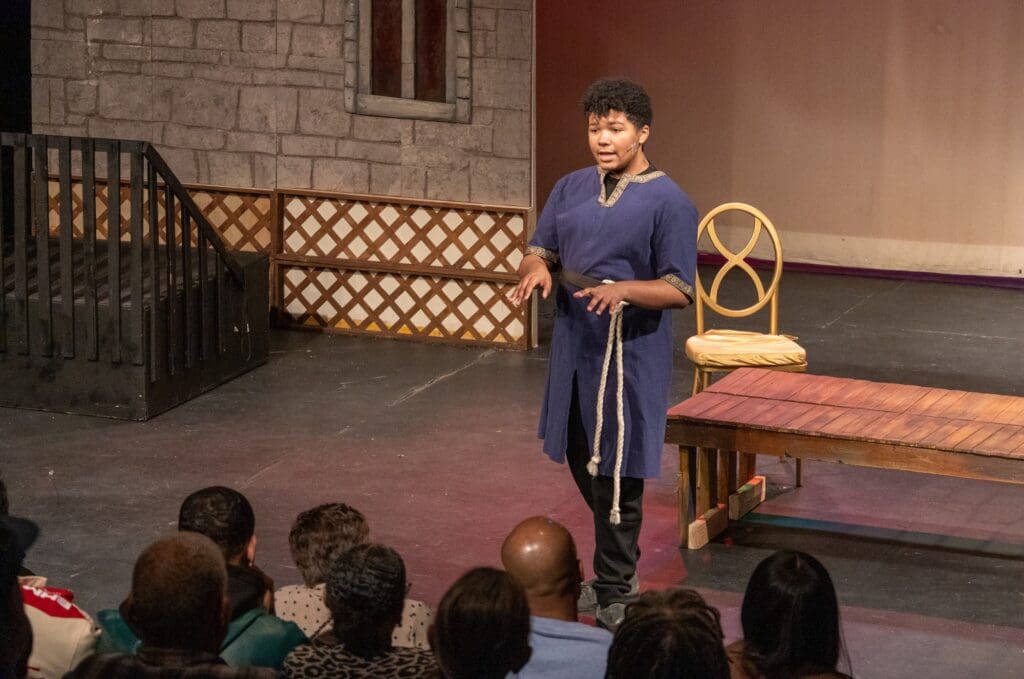
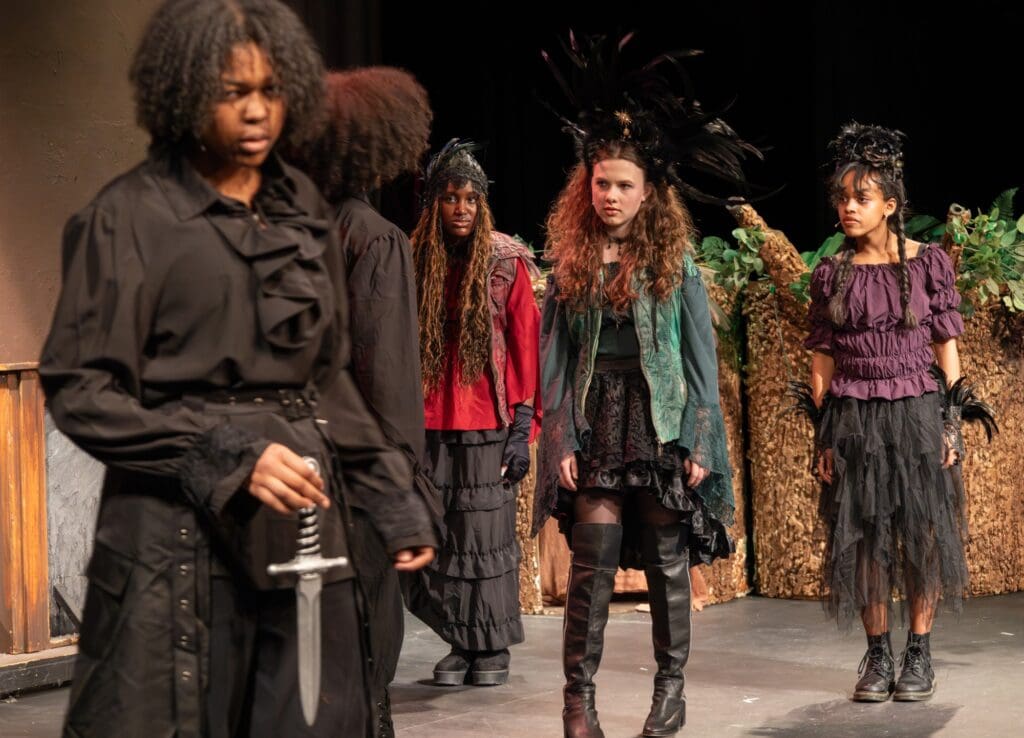
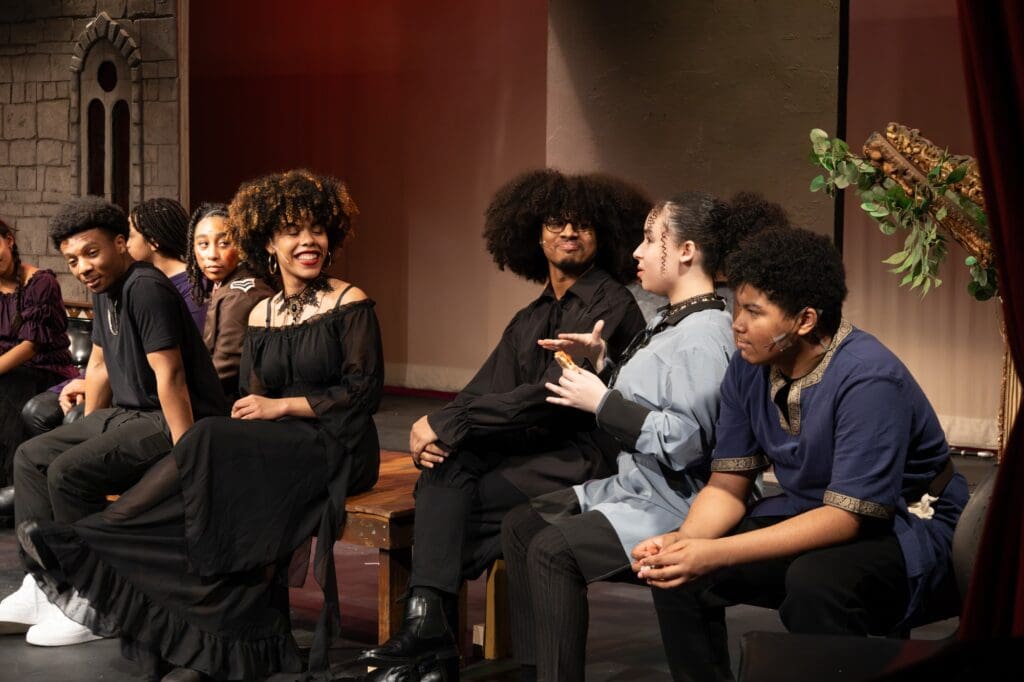
Thus, it is through these lenses that one must appreciate the performance of this cast of thirteen.
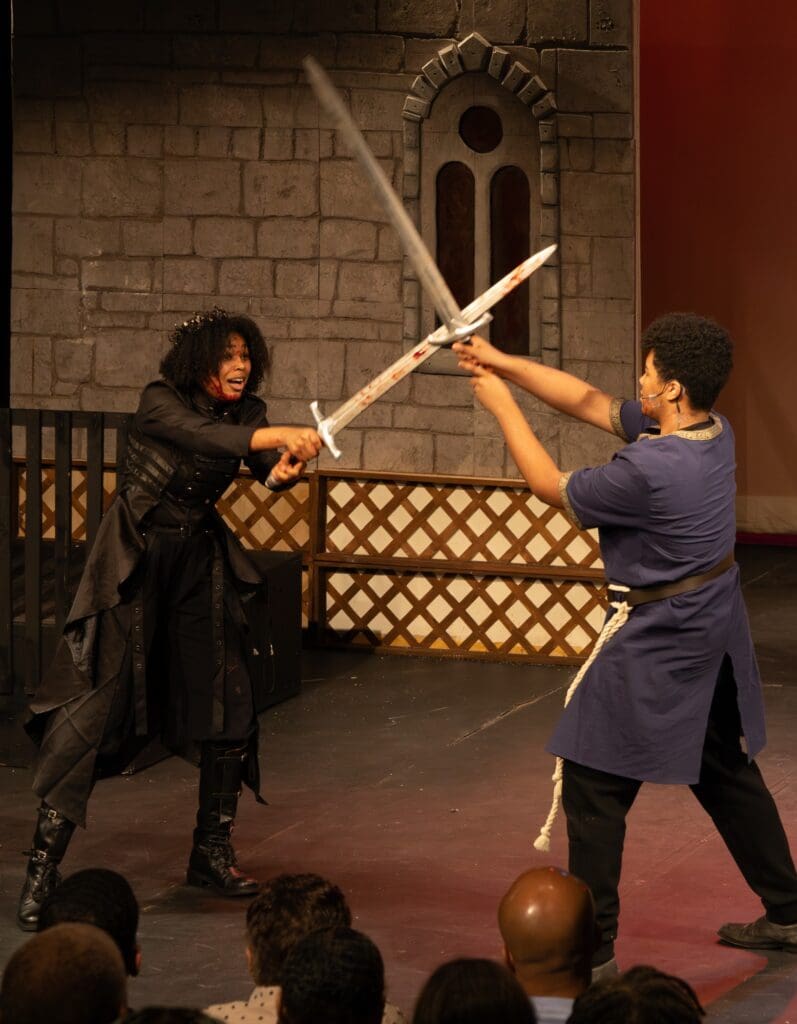
The stage prop was minimalist, allowing the audience to focus primarily on the actors. Costumes
designed for each character’s role were a mixture of the contemporary, a bit of swag, and
Elizabethan aesthetic- enhanced with crowns, swords and blood smeared where necessary.
Costumes that they all agreed during the post-show Q&A, were pivotal to them becoming
grounded in a character. Mercedes did not contemporize the script by shying away from the
Elizabethan-era language infused with iambic pentameter rhythm, the latter a characteristic of
traditional English plays. Authenticity was the goal!
The first of the monologues was a brief excerpt from the comedy As You Like It, chosen by
Mercedes because, in her words, “it deals with finding one’s place in the world.” It began with
the words from the scene that proclaimed, “All the world’s a stage, and all men and women
merely players.” Words that became many a philosopher’s view as to the reality of our existence.
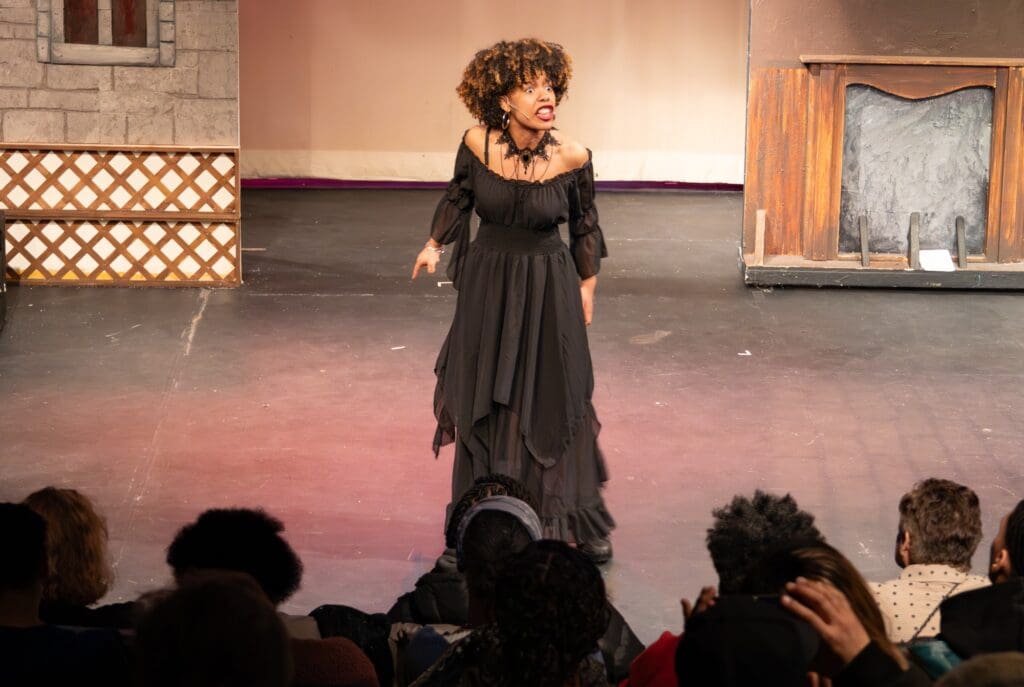
This was followed by two monologues from the timeless romantic tragedy Romeo & Juliet which
includes Juliet’s lament “O, Romeo, Romeo, wherefore art thou Romeo,” heartbroken from the
reality that her lover’s name deemed him her enemy. This segued into the balcony scene with a
lovestruck Romeo, eavesdropping, his emotional outburst “She speaks yet she says nothing, what
of that. Her eyes discourses: I will answer it” and “O that I were a glove upon that hand, that I
might touch that cheek” as he pined for Juliet Othello, Shakespeare’s only play with a Black
leading character was an obvious choice, given that this entire cast were Black and Brown actors.
This monologue was taken from the scene that highlights Othello’s delusion, which includes the
words “I will kill thee and love thee.”
The final and longest of the monologues was an excerpt from the tragedy Macbeth, a king crazed
with ruthless ambition, power lust and paranoia. It was chosen because, to Mercedes, it is
reflective of the current state of the country. The declaration “All hail, Macbeth, that shalt be
king hereafter!” mirrors the politics of today.
That Mercedes accomplished the improbable would be an understatement. Her teenage cast
accepted the challenge to express complex emotions of romantic love & and loss, deception,
jealousy, racism, conflict and unrestrained ambition. Teenagers are also always “trying to find
themselves.” With her encouragement they dug deep and tapped into the universal themes and
emotions. Though young, they would have had or in the future experience such feelings, and
when abstract, imagination, the priceless tool used successfully by professional actors was
employed. And so, they nailed the performance with confidence and conviction spoken in this
strange language- adding their own interpretation, cadences on point and emotions landing where
they should. This from Gen-Zers who inhabit a world in which the artistry of Rap lyrics and
Spoken-Word poetry are familiar and worlds apart from an Elizabethan-era dialect and culture
three centuries ago.
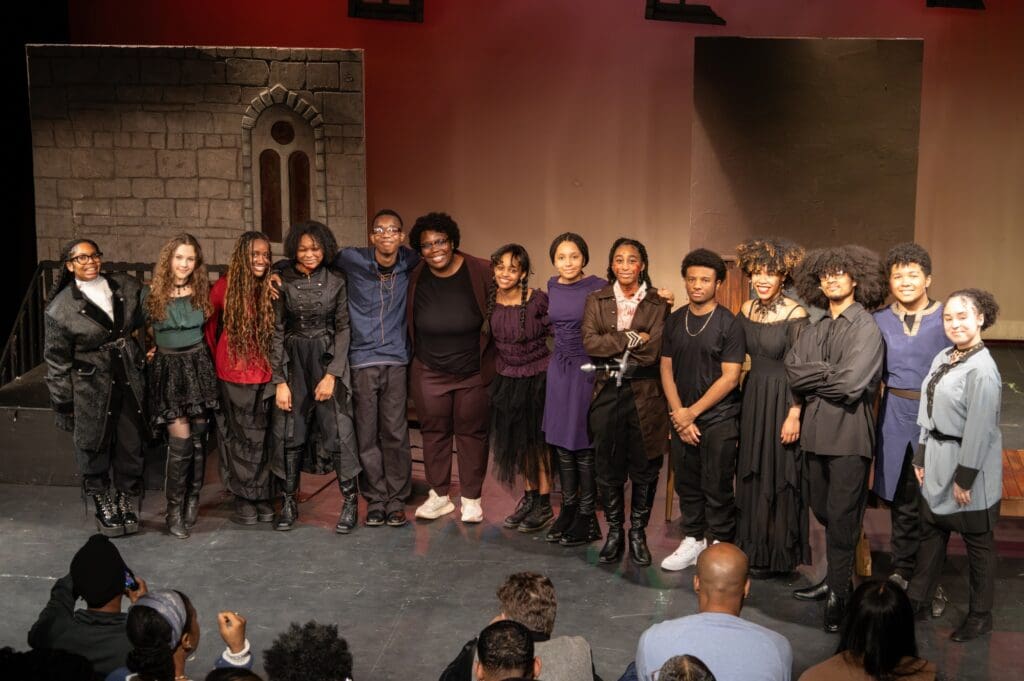
The Q&A session was equally impressive and revealed the brilliance of the actors. Here is where
they discussed with sophistication, their individual “process”- techniques used in developing a
character. “Refining emotions” and ‘scoring monologues & scripts” were mentioned. How
modern versions helped with their understanding of each play. That their different personalities
and by extension, acting skills, inspired each other. And ultimately, that Shakespeare’s work
though complex, is aspirational!
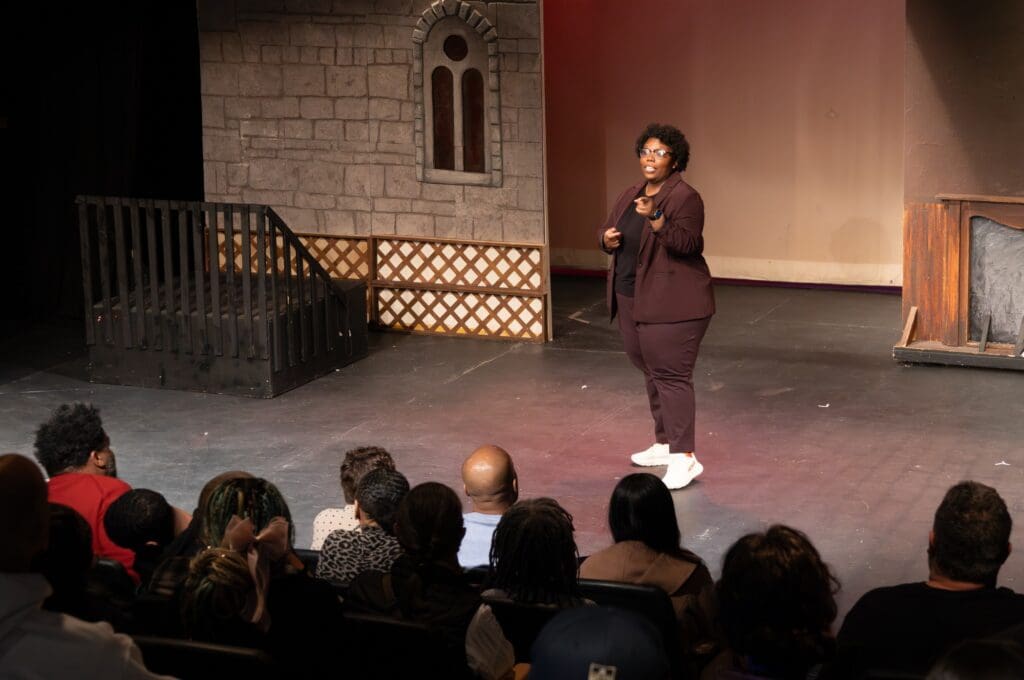
Throughout the performance, one would have noticed Mercedes, stage-side, looking on at her
handiwork with an ever-present smile of pride. Her goal is to encourage black and brown
students to expand their horizons by embracing classical theatrical performances, shattering the
notion that “classical” belongs to an exclusive Eurocentric club. Classical works have been
performed by many successful actors of color that preceded them. It is a where they belong.
After all, The Classical Theatre of Harlem exists!
This experience was inspiring, and because of her commitment, these students are leading the
way. Her hope is that that Shakespeare will be understood and appreciated by all. That this one-
day-only event would be extended and that many New Yorkers would show up. The audience’s
spontaneous standing ovation and rapturous applause; the mother with whom I spoke after the
show, overwhelmed with pride and wearing a megawatt smile as she lauded her daughter’s
performance agree that it should.
Next up, HSA’s spring musical, In the Heights, May 14-16!
Cast List: Calli Belgrave, Nyleek Moore, Aimony Erisnor, Kylie Martoral, Harper Quill, Eva
Carvallo, Landon Ifill, Amber Ward, Harper Cohen, Jmir Smalls, Nala Lopez, Ellem Cabrera,
Bella Brown.