The acclaimed PRISM Quartet is turning music into a conversation about identity, history and the complicated relationship between Black and Jewish Americans with its ambitious new album, “GENERATE MUSIC.”
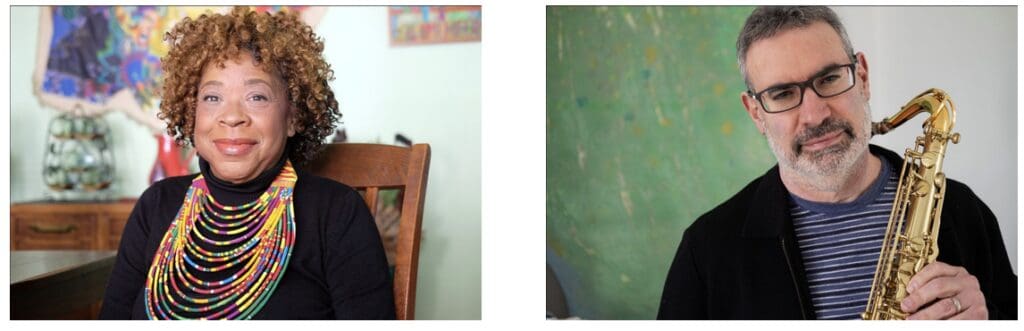
Photos by Willa Rohrer
The all-saxophone ensemble, featuring Timothy McAllister, Zachary Shemon, Matthew Levy and Taimur Sullivan, will release the album Aug. 14. A concert film documenting the project’s June 9, 2024 world premiere at Roulette in New York will also stream for free for one night Aug. 7 at 8 p.m. ET.
“GENERATE MUSIC” grew out of a 2018 PRISM tour stop in Croatia, where the musicians encountered an exhibition about “degenerate music,” the term used by the Nazis to describe music that conflicted with their racist and antisemitic ideology. Among the imagery was a caricature of a Black saxophonist wearing a Star of David.
For PRISM co-founder and director Matthew Levy, who grew up Jewish in Philadelphia’s predominantly Black Germantown neighborhood, the image prompted reflections on his own experiences and the cultural connections he witnessed growing up. The project ultimately became an effort to transform the idea of “degenerate” into “generate” — creating new music that celebrates the histories, contributions and intersections of Black and Jewish communities.
The album features eight newly commissioned works by composers and artists including Yotam Haber, David Krakauer, Myra Melford, Diane Monroe, Ursula Rucker, Tyshawn Sorey, Susan Watts and Fred Wesley, with additional contributions from Levy.
Among the most personal pieces is “Requiem for AJ,” written by Wesley, the renowned trombonist and former musical director for James Brown, with poetry by Rucker, a Philadelphia poet and collaborator with The Roots. The work honors Wesley’s friend, who died young in an automobile accident, while Rucker’s contribution recalls the 1964 murders of James Chaney, Michael Schwerner and Andrew Goodman during Freedom Summer in Mississippi.
Other works explore faith, memory, grief, forgiveness and cultural exchange. Rucker’s “Let Us Gather & Go All Together, Can We?” addresses the lasting impact of her brother’s 1985 killing, while Levy’s “Lament,” originally written for his late father, responds through music as an expression of empathy and mourning.
The album also brings together a remarkable ensemble, including clarinetist Krakauer, violinist Monroe, vocalist Rucker, drummer Sorey, vocalist and trumpeter Watts, guitarist David Gilmore and bassist Reuben Rogers.
Co-curated by PRISM and the late Helen Haynes, “GENERATE MUSIC” is both a musical collaboration and an exploration of how art can confront difficult histories while creating space for understanding.
Rather than offering easy answers, the project embraces complexity, using jazz, klezmer, funk, poetry and contemporary classical music to examine what divides communities — and what can bring them together.