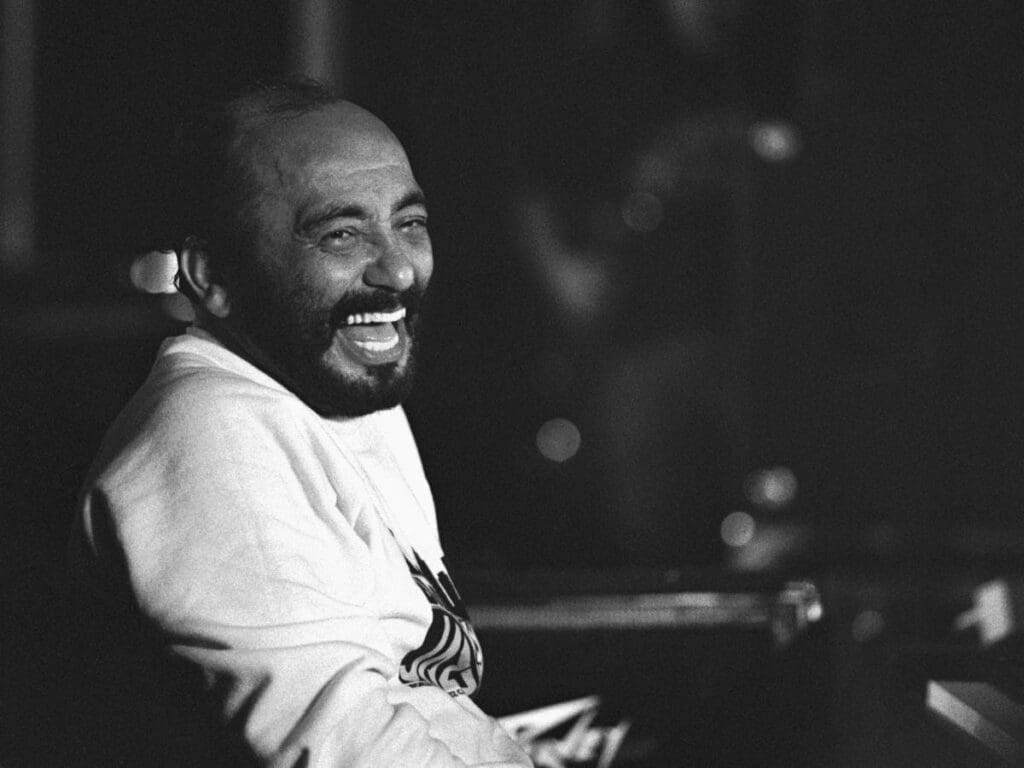
Eddie Palmieri, the legendary pianist and bandleader, passed away in 2025, leaving behind a monumental legacy as one of the most innovative voices in Latin music. Born and raised in El Barrio, East Harlem, Palmieri grew up on 112th Street, just blocks from El Museo del Barrio, and would go on to transform his Puerto Rican roots, New York upbringing, and barrio sensibilities into a universal musical language that resonated worldwide.
Palmieri’s artistry was unmatched in its breadth and daring. He could yell at the piano, caress it, craft Bach-like counterpoint, or sweep across keys in Coltrane-like abandon. He alternated between staying grounded in the tonic and breaking free from it entirely, performing with his fingers, elbows, and unbridled energy. His fearless approach to music earned him the moniker “the madman of Salsa,” a fitting testament to his fearless experimentation and improvisational genius.
Over the decades, Palmieri collaborated with some of the greatest figures in Latin music and beyond, including Vicentico Valdés, Tito Puente, Tito Rodríguez, Joe Quijano, Tito Matos, Carl Tjader, La India, Manny Oquendo, Andy González, and Lila Downs. He was inspired by trailblazers and, in turn, mentored generations of musicians, passing on his knowledge, innovation, and commitment to cultural authenticity.
Palmieri’s dedication to his roots was evident not only in his music but in his community. After the passing of his older brother Charlie Palmieri in 1988, Eddie led the effort to rename the corner of 112th Street and Park Avenue “Charlie Palmieri Way,” honoring the musical lineage and neighborhood that shaped them both. Palmieri understood that the rhythm, swing, and soul of their music sprang from the vibrant streets of East Harlem.
Throughout his career, Eddie Palmieri remained a translator—bridging genres, cultures, and generations. He effortlessly combined the energy of salsa, the sophistication of jazz, and the spirit of the barrio into a sound that was entirely his own. His influence extended far beyond music, touching the lives of audiences, students, and fellow artists who witnessed his boundless creativity and devotion.
As Monxo López, PhD, Curator of Community Histories at the Museum of the City of New York, aptly stated, Eddie Palmieri represents “one of the most precious gifts El Barrio has ever given the rest of the world.” His music, mentorship, and indomitable spirit ensure that El Maestro’s legacy will continue to inspire and resonate for generations to come.
Eddie Palmieri was not just a musician—he was a cultural force, a community pillar, and an enduring symbol of artistic courage.